The business model
The insurance industry business model contains two types of activities: primary and support. Primary activities make up the company's value chain and support activities support the value chain. Support activities may include corporate services, finance, human resources, or information systems and technology.
A value chain provides a functional model for an organization. It models the various functions an organization performs without consideration for how they are performed. It is through the act of defining these processes that roles and responsibilities are defined, and organizational structure comes into view.
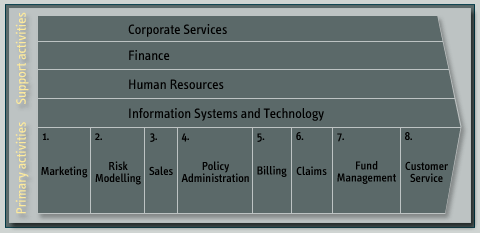
Figure 1: The Insurance Industry Value Chain
A value chain describes the company's product offering from start to finish. An organization that serves more than one type of market may have multiple value chains. The seven primary activities depict the company's value chain as an end-to-end process:
- Marketing: The first step in the value chain process is marketing. At this point, a business must determine which policies it will offer.
- Risk Modeling: As part of marketing, a business must determine the policy mix and pricing strategy. To determine how premiums will be calculated for each policy, the business must also perform risk modeling. Using the information gathered from risk modeling, the business can then determine the actual prices for each policy.
- Sales: The business is now in a position to begin selling its insurance policies to customers. Selling involves quotations, proposals, risk assessments, and commission calculations. Commissions are paid to all parties involved in the distribution channel.
- Policy Administration: Having sold a policy, the next step is to write the policy.
- Billing: Customers can be billed once their policies have been written.
- Claims: Customers who have paid their premiums may at some point make a claim. This activity is optional, however, as customers may never make a claim.
- Customer Service: The customer service activity involves serving the needs of customers until their policies expire.
Each activity contains a number of processes that support the activity, although not all processes within a primary activity necessarily directly contribute to the value chain. A primary activity must contain at least one process that contributes to the value chain.
Key stakeholders
Many people contribute to the running of an insurance company. Aside from shareholders, the key stakeholders in the insurance value chain are:
- Consumers who buy insurance products.
- Investors that support insurance companies by purchasing insurance company stock.
- Insurance carriers that provide insurance coverage through policies and accept the risks covered by the policies. These are generally large insurance companies, including direct insurers and reinsurers.
- Partners who couple with insurance companies to share profits and losses. Partners include reinsurers, institutional investors, and trade partners. Partners also include the insurance agencies and brokerages that distribute insurance products.
- Outside networks that include those that perform professional services for insurers. They include appraisers, insurance bureaus, reinsurers, claims adjusters, and firms providing consulting, claims processing, and data collection services.
- Regulators and auditors that help secure the financial health of the insurance industry. Regulators implement and enforce regulations, while auditors ensure adherence to finance and accounting standards.
- Vendors that supply the goods insurers require to perform business activities. Examples include software distributors and administrative goods suppliers.
How money is made
A concise and simplified representation of the revenue and cost flow of the insurance business model is: profit = earned premium + investment income - incurred loss - underwriting expenses.

Figure 2: Profit formula
This profit formula explains where money comes from and where it goes. In other words, it depicts the revenue and cost flow of the insurance business model. Money comes from earned premium and investment income and goes to incurred loss and underwriting expenses.
Earned premium, a source of income, is the total of all the premium payments received by an insurer for the current coverage period. Premiums are not considered "earned" until the policy period they cover is over. Investment income is the residual income generated as a result of investing premiums in the capital markets. Investment income also includes annuity considerations and asset earnings. Incurred loss is the sum of all claims paid, adjusted by the change in claims reserve and related claim expenses for the same accounting period. Incurred loss contributes to cost flow. Finally, underwriting expenses include all the costs associated with a policy, including commissions and the portion of administrative, general, and other expenses attributable to underwriting.
The Competitive Landscape
Abstract
This article identifies the key competitors in the insurance industry by their respective sectors.
Key Competitors
As potential purchasers of insurance, customers want to feel there is a big, powerful company securing their assets. Larger companies tend to project a sense of satisfaction and security. This size advantage has had an impact on smaller companies, despite the fact that they often provide service on par with the larger, more established international players. Regardless of the size of the company, it's important to identify some of the biggest industry leaders and their areas of specialization.
In times of mergers, absorbs, and split-offs, it's not always easy to keep track of the top players. This list of industry leaders is divided into three main sectors:
- property and casualty insurance
- life insurance companies
- specialty insurance
The presence of companies on this list is based on the latest available indicators: sales, profits, assets, and market value.
Property and casualty insurance
Allianz Group
Headquartered in Munich, Germany, Allianz Group is a global services provider in insurance, as well as other financial services. Allianz is considered to be the leader in the German insurance market and also has a strong international presence.
Allianz was founded in 1889 by the director of Münchener Rückversicherungs-Gesellschaft (Munich Re), Carl Thieme, and Munich banker Wilhelm Finck. The company gradually became international, beginning with a branch office in London in the late 19th century, followed by an office in Paris in the late 1950s, and a management office in Italy in the 1960s.
Allianz Group currently employs over 180,000 people around the world and serves more than 75 million customers in approximately 70 countries.
American International Group, Inc. (AlG)
Founded in 1919 by Cornelius Vander Starr, AlG is a leading insurer headquartered in New York City, USA, with operations in more than 130 countries and jurisdictions. AlG companies serve commercial, institutional, and individual customers through a worldwide property-casualty and life insurance network. AlG's common stock is listed on the New York Stock Exchange, and stock exchanges in Ireland and Tokyo.
A major milestone in the company's history was its near bankruptcy in September, 2008. According to industry reports, the relatively small London unit, AlG Financial Products, was involved in credit derivative transactions that very nearly resulted in the collapse of the company. As a result, AIG required a bailout from the US Federal Reserve.
Life insurance companies
ING Group
ING is a global financial services company headquartered in the Netherlands that provides life insurance in addition to other services. It serves more than 85 million customers throughout Europe, the United States, Canada, Latin America, Asia, and Australia.
ING was established in 1991 following a merger between Nationale-Nederlanden and NMB Post bank group. Since that time, ING has become a multinational company that offers a variety of international products. The insurance elements of its six clear business lines include Insurance Europe, Insurance Americas, and Insurance Asia/Pacific.
AXA Group
AXA Group, with its group headquarters in Paris, France, is a global insurance company. Founded in 1985 by Claude Bébéar, AXA's organizational structure is such that it is not the name of a single company, but rather a group of companies organized independently and operated according to the regulations of many different countries.
The AXA insurance business lines include life, health, and other forms of insurance. The AXA group has its operations located primarily in Western Europe, North America, the Asia Pacific region, and the Middle East.
Generali Group (Assicurazioni Generali)
The Generali Group is a major player in the global insurance marketplace. Founded in 1831 in Trieste, Italy, it is the insurance market leader in Italy and operates in more than 65 countries. The Generali Group, and its consolidated partnerships with major international reinsurers, operates in all sectors of the insurance industry, including life and annuity, property and casualty, and specialty.
One of the major milestones in the company's history was in 1918 when it obtained full Italian nationality status with its share capital converted into lira. The Generali Group currently operates through approximately 330 consolidated subsidiaries, of which nearly half are insurance companies.
Specialty insurance
Munich Reinsurance Company
Based in Germany, Munich Re was founded in 1880 by the founder of Allianz, Carl von Thieme. Munich Re operates in over 160 countries, has approximately 5,000 reinsurance customers, and depends on 46,000 employees to carry out its business. Munich Re is the world's largest reinsurance company, providing insurance protection to most of the world's largest insurance firms.
Two major milestones in the company's history include 9/11 and Hurricane Katrina. In the aftermath of the 9/11 terrorist attacks in New York, Munich Re reported the largest loss in its history. Hurricane Katrina, in 2005, resulted in an additional financial burden estimated at $1.6 billion USD.

No comments:
Post a Comment